• Indo-Iranian Journal 68, 3

    Indo-Iranian Journal 68, 3

    Indo-Iranian Journal volume 68, issue 3 (November 2025) has been published (as always h/t @yaleclassicslib.bsky.social‬). Sims-Williams has an open access article on Bactrian:

    Sims-Williams, Nicholas. 2025. Bactrian in two scripts: Greek and Kushan. Indo-Iranian Journal. Brill 68(3). 185–214.

  • Like dust on the Silk Road

    Like dust on the Silk Road

    Bernard, Chams Benoît. 2025. Like dust on the Silk Road: On the earliest Iranian and BMAC loanwords in Tocharian (Leiden Studies in Indo-European 27). Leiden: Brill.

    This volume is open access. Follow the link above.

    “How did the Tocharians reach China?” “Who did they meet on the way?” are some of the most intriguing questions in Indo-European studies. This book is zooming in on a specific part of the question: on their way to China, Tocharians were in contact with an Iranian people living in the south Siberian Steppes, and with a people related to the Oxus Civilization (BMAC). This Iranian people spoke a specific language, called here “Old Steppe Iranian”. They gave Tocharians many words, such as mañiye ‘servant’, etswe ‘burden-carrying horse’ or ‘mule’, pāke ‘portion, share’. The BMAC-related people gave the Tocharians other words such as etre ‘hero’ and kercapo ‘donkey’. This book reconstructs features of the language of both these peoples, and examines how they influenced the Tocharians. Based on the latest archaeological findings, it also suggests a reconstruction of the chronology and the way the Tocharians followed before entering the Tarim Basin.

  • The Formation of the Sasanian Empire: Administration and Elites in Comparison with the Roman Empire

    The Formation of the Sasanian Empire: Administration and Elites in Comparison with the Roman Empire

    Purwins, Nils. 2025. Der Aufbau des Sasanidenreiches: Administration und Eliten im Vergleich zum Römischen Reich (Ancient Iran Series 18). Leiden: Brill.

    The work provides in two volumes the first comprehensive overall concept of the administrative and social structure of the Sasanian Empire (5th-7th century). In more than 1.000 contemporary leather documents, seals, ostraca, inscriptions and texts, which are brought together here for the first time, the subjects of the king of kings report in words and pictures on their lives in the various provinces of the empire, on the organisation of the military, civil and religious administration and on the circles of power at the court of their ruler. At the same time, this work offers the first systematic structural comparison with the Eastern Roman Empire, so that the organisations of two ancient empires are treated here with a wealth of supporting illustrations, diagrams and maps. The aim is nothing less than to answer the question of the extent to which Ērānšahr and the Imperium Romanum really were the “two eyes that illuminate the world from above”, as the Great King Husraw II is said to have once claimed (Theophylaktos).

  • The Unfinished Story of the Babylonian Version of the Bīsotūn (Behistun) Inscription (DB Bab.)

    Hackl, Johannes. 2025. The Unfinished Story of the Babylonian Version of the Bīsotūn (Behistun) Inscription (DB Bab.). Iraq. Published online 2025:1-20. doi:10.1017/irq.2025.10033

    This article revisits the editorial history of the Babylonian (Akkadian) version of the Bīsotūn (Behistun) Inscription (DB) to establish the extent of the surviving text in light of a re-examination of the inscription at Mount Bīsotūn (Behistun). Questions arising about the reliability of the standard edition presented in Von Voigtlander (1978) prompted a critical review of her new readings, which significantly expand the text by approximately two-thirds compared to what previous commentators recorded and what is visible on the rock face today. The article focuses on the results of this scrutiny, supported by information from Von Voigtlander’s correspondence with George G. Cameron and Matthew W. Stolper, highlighting the implications of their discussions.

  • The Academic Research Segment

    The Academic Research Segment

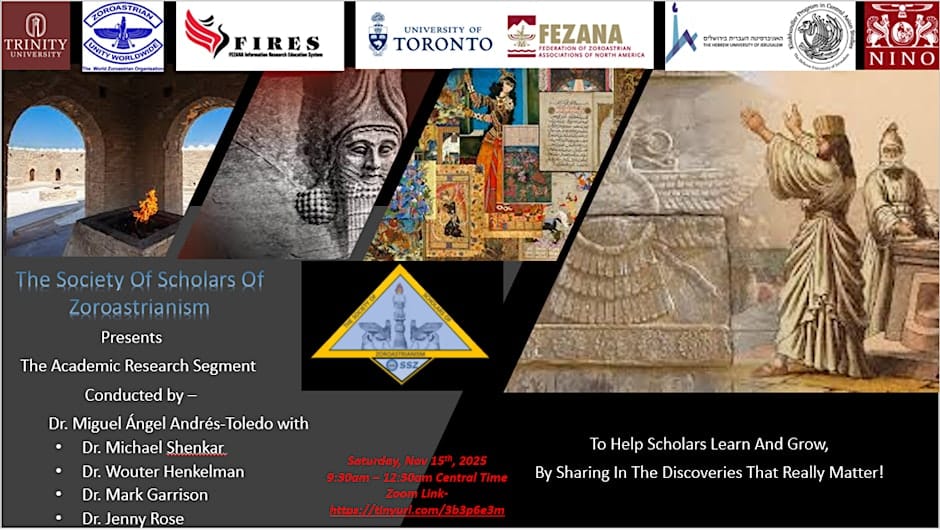
    The Society of Scholars of Zoroastrianism presents The Academic Research Segment.

    The Academic Research Edition of the Society of Scholars of Zoroastrianism presents ‘a deep dive into the newest discoveries in the world of Zoroastrianism’. This is an online event taking place on 15 November 2025 from 3:30 to 6:30pm GMT.

    Please visit this link for further details.

    The participants are:

    • Dr. Michael Shenkar: The Cult of Fire in Sogdiana; New Evidence from Sanjar Shah
    • Dr. Miguel Andres Toledo: The Poetry of Ahura Mazdā’s Creation: Metrical Philosophy in Dēnkard 3
    • Dr. Henkelman: The Achaemenids and Central Asia. The Evidence from the Persepolis Fortification Archive
    • Dr. Garrison: The Zoroastrian Question in Achaemenid Fārs. Insights from the Persepolis Fortification Archive
  • Manichaeism and Church History

    Manichaeism and Church History

    Toft, Lasse Løvlund, Mattias Sommer Bostrup & René Falkenberg (eds.). 2025. On the Matter. Studies on Manichaeism and Church History Presented to Nils Arne Pedersen at Sixty-Five (Corpus Fontium Manichaeorum – Analecta Manichaica 4). Turnhout: Brepols Publishers.

    The anthology consists of twenty-nine studies on Manichaean texts in Coptic, Syriac, Chinese, and Iranian languages, as well as on broader Church History including texts from the Nag Hammadi Codices, Coptic and Syriac heresiology and Early Modern religious polemics. Of interest to all scholars of Manichaeism and Late Antique and Medieval Eastern Christianity, and to scholars working on the phenomenon of heresiology and doctrinal polemics within the churches at large. The anthology is a Festschrift for Nils Arne Pedersen at Aarhus University.

    TABLE OF CONTENTS

    Manichaean Texts, Imagery, and Terminology

    • Jean-Daniel Dubois, About the Use of the Term Pistos in Coptic Manichaean Writings
    • Iain Gardner, Who Was Salmaios and What Was His Lament?
    • Jason BeDuhn, Rethinking Manichaean Asceticism
    • Samuel N.C. Lieu, Database of Manichaean Texts – Past, Present, and Future
    • Claudia Leurini, Secret Messages: Traces of Cryptography in the Middle Persian Manichaean Hymns to the Church
    • Iris Colditz, Eine Parabel in einer Homilie Manis in parthischer Sprache
    • Yutaka Yoshida, Middle Iranian Fragments in Sogdian Script from the St. Petersburg Collection – The Fourth Section of the Manichaean Daily Prayers in Parthian and Some Other Middle Iranian Texts
    • Nicholas Sims-Williams, On the Sources of the Manichaean Sogdian Religious Terminology
    • Enrico Morano, A Manichaean Middle Persian Text on the Descent of the Holy Spirit and the Beginning of Mani’s Church (M788)
    • Gunner Mikkelsen, Pearl Imagery in a Chinese Manichaean Hymn
    • John Møller Larsen, Ligatures in the Syriac Manichaean Texts from Kellis
    • Erica C.D. Hunter, Hunting Manichaean Syriac Incantation Bowls
    • Sebastian P. Brock, Imagery Shared and Imagery Avoided: The Manichaean Psalms and Syriac Religious Poetry

    Nag Hammadi, the Bible, and Early Heterodoxy

    • Einar Thomassen, Manichaeans and Gnostics on the Creation of Humanity
    • Hugo Lundhaug, A Luminous Soul in the Likeness of God: Dispensing with the Psychic God in Paul’s Prayer for Revelation in Nag Hammadi Codex I
    • Anders Klostergaard Petersen, The Gospel of Truth as Fully-Fledged Christ Religion
    • Peter Nagel (†), Das Gleichnis vom viererlei Acker in den synoptischen Evangelien und im Thomasevangelium (Logion 9)
    • Mogens Müller, Traces of Marcion in the New Testament?

    Eastern Orthodoxies in Formation

    • Jan Dochhorn, Acherusischer See und Paradies im Zauberpapyrus London, Brit. Libr. Or. 5987, l. 13–24
    • Lasse Løvlund Toft, Virgin Mary as a Heavenly Power in Egypt: Doctrinal Polemics and Theological Diversity in Coptic and Copto-Arabic Homiletic Apocrypha on the God-bearer
    • David G.K. Taylor, Eschatological Rivers of Fire and Purgatorial Purification in Sixth-Century Syriac Texts
    • Flavia Ruani, Le catalogue d’hérésies de Jacques bar Šakko (XIIIe s.) :Livre des trésors II. De l’Incarnation du Verbe, ch. 1
    • Paul-Hubert Poirier (†), Une traduction latine inédite du Contra Manichaeos de Titus de Bostra
    • Henning Lehmann, Eusebius of Emesa Interpreting Exod. 3:14f: Some Remarks on Recent Eusebius Studies

    Churches, and Theologies in Early Modern and Modern Northern Europe

    • Per Ingesman, ‘In Principio Erat Error, Et Error Erat Apud Lutherum’: Paulus Helie on Luther and His Adherents in the Danish Reformation
    • Rasmus H.C. Dreyer, Between Danish and German: A First-Generation Danish Reformer as Lutheran Superintendent (1541–1561)
    • Carsten Bach-Nielsen, Theme and Variations: Lazarus and the Rich Man. Iconography of a New Testament narrative in an age of Reform, c. 1500–1640
    • Kim Arne Pedersen, Grundtvig, the Greeks, and Heresy
    • Mattias Sommer Bostrup, The Life and Afterlives of Bishop Fredrik Nielsen (1846–1907): Social Functions of Church History at the Fin de Siècle
  • The Pahlavi Papyri in their Historical Context

    The Pahlavi Papyri in their Historical Context is the second round of the Pahlavi Papyri Workshop to be held in Innsbruck: Tuesday, 25 November – Wednesday, 26 November 2025. The workshop is organized by Bernhard Palme, Robert Rollinger and Touraj Daryaee.

    Address: Seminar rooms 04K100/04M100 (4th floor) and 14 (1st floor), Ágnes-Heller-Haus, Innrain 52a, 6020 Innsbruck

    To see the program, click here.

  • Chotano-Sogdica. Linguistic Studies on Sogdian and Khotanese

    Chotano-Sogdica. Linguistic Studies on Sogdian and Khotanese

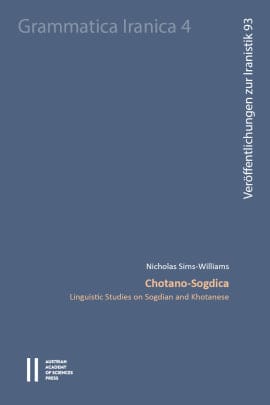
    Sims-Williams, Nicholas. 2025. Chotano-Sogdica. Linguistic Studies on Sogdian and Khotanese (Grammatica Iranica, 4). Vienna: Austrian Academy of Sciences Press.

    Über ein halbes Jahrhundert lang, seit 1972, hat Nicholas Sims-Williams viele wichtige Artikel über die älteren iranischen Sprachen veröffentlicht, insbesondere über das östliche Mitteliranisch (Sogdisch, Baktrisch und Khotanisch). Nahezu alle seine Artikel über Sogdisch und Khotanisch sind im vorliegenden Band zusammengefasst, zusammen mit drei völlig neuen Artikeln mit den Titeln „Is there a ‘predicative instrumental’ in Sogdian?“, „Yaghnobi and the Sogdian ‘Rhythmic Law’“ und „The locative singular in Old Khotanese“. Die Ergänzungen und Korrekturen, die aufgrund der fünfzigjährigen Fortschritte im Verständnis dieser Sprachen notwendig geworden sind, werden durchgehend hinzugefügt, jedoch sorgfältig vom Originaltext getrennt, um das Auffinden von Verweisen auf frühere Versionen zu erleichtern. Das Buch wird durch detaillierte Register ergänzt und ist ein unverzichtbares Nachschlagewerk für Studierende und Wissenschaftler, die sich für zentralasiatische Geschichte und Literatur sowie für iranische und indogermanische Linguistik interessieren.

  • The Zoroastrian funeral ritual for living souls

    Nayebossadrian, Zhaleh. 2025. The Zoroastrian funeral ritual for living souls. Culture and Religion. 1-14.

    This study presents a comprehensive investigation into a Zoroastrian funerary rite, ‘Zīnda-ruwān-yaštan’, performed during their lifetime for the well-being of their living soul. The research draws on Zoroastrian scriptures and ethnographic sources to trace the origins and eventual decline of the ‘Zīnda-ruwāni’ ritual through a combination of historical, textual, and epigraphic analysis. The finding emphasises the ritual’s adaptability in response to evolving socio-political circumstances. Concentrating on ‘Srōš Yazata’, the divine entity believed to guide souls following death, the ceremonial practice underscores its profound spiritual import in assuaging death anxieties. The study makes a significant contribution to our understanding of the evolution of Zoroastrian funerary customs within various historical contexts. It demonstrates how Zīnda-ruwāni functioned to alleviate death-related anxieties within a dynamic socio-religious milieu, providing reassurance amid political and economic instability.

  • Achaemenid court logistics between royal capitals of Susa and Persepolis

    Achaemenid court logistics between royal capitals of Susa and Persepolis

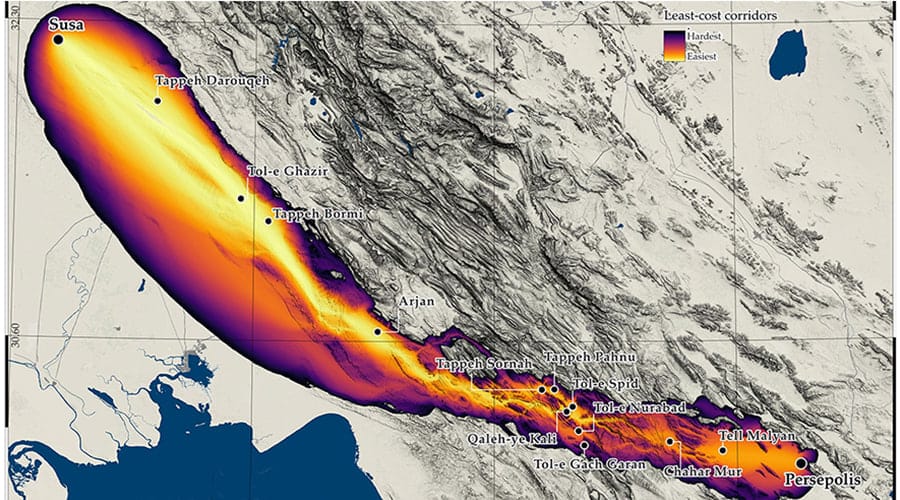
    Salaris, Davide. 2025. ‘Royal’ road, ‘royal’ needs: a GIS-based approach to Achaemenid court logistics between royal capitals of Susa and Persepolis. Antiquity. Published online 2025:1-8.

    This article redefines the concept of the Achaemenid ‘Royal’ Road using GIS-based route modelling to reconstruct possible roads between Susa and Persepolis. By integrating logistical and environmental parameters, it shows how royal mobility required a specialised infrastructure—distinct from ancillary roads—tailored to the operational scale of the Achaemenid court.