Larson, Richard K., Sedigheh Moradi & Vida Samiian (eds.). 2020. Advances in Iranian Linguistics (Current Issues in Linguistic Theory, 351). Amsterdam & Philadelphia: John Benjamins Publishing Company.
This volume brings together selected papers from the first North American Conference in Iranian Linguistics, which was organized by the linguistics department at Stony Brook University. Papers were selected to illustrate the range of frameworks, diverse areas of research and how the boundaries of linguistic analysis of Iranian languages have expanded over the years. The contributions collected in this volume address advancing research and complex methodological explorations in a broad range of topics in Persian syntax, morphology, phonology, semantics, typology and classification, as well as historical linguistics. Some of the papers also investigate less-studied and endangered Iranian languages such as Tat, Gilaki and Mazandarani, Sorani and Kurmanji Kurdish, and Zazaki. The volume will be of value to scholars in theoretical frameworks as well as those with typological and diachronic perspectives, and in particular to those working in Iranian linguistics.
This collection of essays presents a synthesis of current research on the Oxus Civilization, which rose and developed at the turn of the 3rd to 2nd millennia BC in Central Asia.
First discovered in the 1970s, the Oxus Civilization, or the Bactria–Margiana Archaeological Complex (BMAC), has engendered many different interpretations, which are explored in this volume by an international group of archaeologists and researchers. Contributors cover all aspects of this fascinating Bronze Age culture: architecture; material culture; grave goods; religion; migrations; and trade and interactions with neighboring civilizations, from Mesopotamia to the Indus, and the Gulf to the northern steppes. Chapters also examine the Oxus Civilization’s roots in previous local cultures, explore its environmental and chronological context, or the possibly coveted metal sources, and look into the reasons for its decline.
The World of the Oxus Civilization offers a broad and fascinating examination of this society, and provides an invaluable updated resource for anyone working on the culture, history, and archaeology of this region and on the multiple interactions at work at that time in the ancient Near East.
Potts, Daniel. 2020. Slings and slingers in ancient Iran. In Stephan Blum, Turan Efe, Tobias Kienlin & Ernst Pernicka (eds.), From past to present. Studies in memory of Manfred O. Korfmann (Studia Troica Monographien 11). Bonn: Verlag Dr. Rudolf Habelt GMBH.
In 1973 Manfred Korfmann wrote, ›it is clear that archaeological work in the future must pay more attention to the sling as a prehistoric weapon of major significance, not only in the Near East but also elsewhere in the world. Even with our present limited knowledge it is clear that the slinger and the archer were equals for thousands of years‹ (Korfmann 1973, 42). Although slings and slingers in ancient Mesopotamia have been studied (e.g. Eichler 1983; Schrakamp 2010, 19), no study specifically dedicated to the use of the sling in ancient Iran has, to my knowledge, ever been published and it is my hope that this modest effort would have pleased Manfred Korfmann, whose attention to the topic (Korfmann 1972; 1973) was the inspiration for my own foray into this fascinating field.
Robert Crellin & Jügel, Thomas (eds.). 2020. Perfects in Indo-European languages and beyond (Current Issues in Linguistic Theory 352). Amsterdam & Philadelphia: John Benjamins Publishing Company.
This volume provides a detailed investigation of perfects from all the branches of the Indo-European language family, in some cases representing the first ever comprehensive description. Thorough philological examinations result in empirically well-founded analyses illustrated with over 940 examples. The unique temporal depth and diatopic breadth of attested Indo-European languages permits the investigation of both TAME (Tense-Aspect-Mood-Evidentiality) systems over time and recurring cycles of change, as well as synchronic patterns of areal distribution and contact phenomena. These possibilities are fully exploited in the volume. Furthermore, the cross-linguistic perspective adopted by many authors, as well as the inclusion of contributions which go beyond the boundaries of the Indo-European family per se, facilitates typological comparison. As such, the volume is intended to serve as a springboard for future research both into the semantics of the perfect in Indo-European itself, and verb systems across the world’s languages.
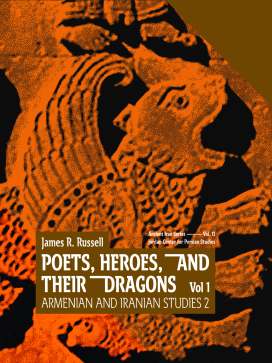
Russell, James R. 2020. Poets, Heroes, and their Dragons: Armenian And Iranian Studies (Ancient Iran Series 13, 1-2). 2 vols. Irvine, CA: Jordan Center for Persian Studies, University of California, Irvine.
The present volume is a collection of articles published by Professor James R. Russell of Harvard University, in various journals over the past decades. James Russell has been one of the pioneers in the field of Armenian and Iranian Studies, where he has demonstrated the importance of Iranian civilization for pre-Christian Armenia.
Table of Contents
VOL. 1
“Two Roads Diverged: Ancient Cappadocia and Ancient Armenia,” in R.G. Hovannisian, ed., Armenian Kesaria/Kayseri and Cappadocia, UCLA Armenian History and Culture Series, Historic Armenian Cities and Provinces 12, Costa Mesa, CA: Mazda, 2013, pp. 33-42.
“A Note on Armenian hrmštk-el,” in Uwe Bläsing, Victoria Arakelova, and Matthias Weinreich, eds., Studies on Iran and the Caucasus in Honour of Garnik Asatrian, Leiden: Brill, 2015, pp. 365-371.
“An Armenian Spirit of Time and Place: The Švot,” Revue des Etudes Arméniennes 1936 (2014-2015), pp. 13-59.
“The Epic of Sasun: Armenian Apocalypse,” in Sergio La Porta, ed., The Armenian Apocalyptic Tradition, Leiden: Brill, 2014, pp. 41-77.
“Language of Demons, Language of Men,” in publication, Festschrift Michael Stone, ed. Theo Van Lint, forthcoming
“The Cross and the Lotus: The Armenian Miscellany Patmut‘iwn płnje k‘ałak‘i (‘History of the City of Brass’),” in Vesta Curtis and Sarah Stewart, eds., The Rise of Islam (The Idea of Iran, Vol. 4), London: I.B. Tauris, 2009, pp. 71-81.
“On an Armenian Word List from the Cairo Geniza,” Iran and the Caucasus 17 (2013), pp. 189-214.
“The Vision of the Painting: Alexander Kondratiev’s Novella Dreams,” Alexander A. Sinitsyn and Maxim M. Kholod, eds., Koinon Dōron: Studies and Essays in Honour of Valery P. Nikonorov on the Occasion of His Sixtieth Birthday presented by His Friends and Colleagues, St. Petersburg: St. Petersburg State University Faculty of Philology, 2013, pp. 323-354.
“Heaven Is Here and the Emperor Is Near: A Traveler’s Guide to Heaven,” Academic Forum Collected Papers: The unity of Humanity and Heaven and Civilizational Diversity, Beijing, China: Institute for Advanced Humanistic Studies, PKU, 2014, pp. 191-222.
“The Interrupted Feast,” in Bernard Outtier, Cornelia B. Horn, Basil Lourié, and Alexey Ostrovsky, eds., Armenia between Byzantium and the Orient: Celebrating the Memory of Karen Yuzbashian (1927-2009), Leiden: Brill, 2019, pp. 468-529.
“Hārūt and Mārūt: The Armenian Zoroastrian Demonic Twins in the Qur’ān Who Invented Fiction,” in S. Tokhtasev and P. Luria, eds., Commentationes Iranicae: Sbornik statei k 90-letiyu V.A. Livshitsa, St. Petersburg: Institute of Oriental Manuscripts of the Russian Academy of Sciences and Nestor-Historia, 2013, pp. 469-480.
“The Curving Shore of Time and Space: Notes on the Prologue to Pushkin’s Ruslan and Ludmila,” in Steven Fine and Shai Secunda, eds., Shoshannat Yaakov: Jewish and Iranian Studies in Honor of Yaakov Elman, Leiden: Brill, 2012, pp. 318-365.
“Early Armenian Civilization,” in Edmund Herzig and Marina Kurkchiyan eds., The Armenians: Past and present in the making of national identity, London and New York: Routledge Curzon, 2005, pp. 23-40.
“Magic Mountains, Milky Seas, Dragon Slayers, and Other Zoroastrian Archetypes,” Bulletin of the Asia Institute 22, Ann Arbor, MI, 2008 [2012], pp. 57-80).
“Armenian Secret and Invented Languages and Argots,” Acta Linguistica Petropolitana, Transactions of the Institute for Linguistic Studies, Russian Academy of Sciences, St. Petersburg, Vol. VIII, part 3, St. Petersburg: Nauka, 2012, pp. 602-684.
“The Demon Weed,” Bulletin of the Asia Institute 19, 2009, pp. 131-134. 445
“The Shrine Beneath the Waves,” RES 51, Cambridge, MA, Spring 2007, pp. 136-156.
“The Memory Palace of St. Grigor Narekac‘i,” Hask hayagitakan taregirk‘ New Series, Year X, 2002-2006, Antelias, Lebanon, 2006, pp. 59-81.
“The Science of Parting: Eliade, Iranian Shamanism, and the View from Tomis,” Studia Asiatica XI, Bucharest, 2010.1-2, pp. 89-97.
“The Bells: From Poe to Sardarapat,” Journal of the Society for Armenian Studies 21 (2012), pp. 127-168.
“Misak‘ Medzarents‘: The Calm Before the Storm,” lecture at Boston University, 13 Oct. 2010.
“The Book of the Way (Girk‘ Chanaparhi) of Yeghishe Charents: An Illuminated Apocalyptic Gospel for Soviet Armenia,” Armenian Studies Program Occasional Paper Series, University of California, Berkeley, Stephan Astourian, ed., Spring 2012.
“Frik: The Bridge of Poetry,” Anathemata Heortika: Studies in Honor of Thomas F. Mathews, ed. Joseph D. Alchermes, Mainz: Philipp Von Zabern, 2009, pp. 256-264.
“Sasanian Yarns: The Problem of the Centaurs Reconsidered,” La Persia e Bisanzio, Roma: Accademia Nazionale dei Lincei, 2004, pp. 411-438.
“Solov’i, Solov’i,” St. Nersess Theological Review 10 (2005), pp. 77-139. 679
VOL. 2
“An Armenological Note on Kartīr’s Vision,”Dasturji Dr. Hormazdyar Dastur Kayoji Mirza Birth Centenary Memorial Volume, Udvada (Gujarat, India): Dastur Kayoji Mirza Institute, 2010, pp. 253-258.
“The Rime of the Book of the Dove (Stikh o Golubinoi knige): From Zoroastrian cosmology and Armenian heresiography to the Russian novel,” in Christine Allison, Anke Joisten-Pruschke, and Antje Wendtland, eds., From Daena to Din: Religion, Kultur und Sprache in der iranischen Welt, Wiesbaden: Harrassowitz, 2009, pp. 141-208 (Festschrift Prof. Dr. Philip Kreyenbroek).
“On an Armenian Magical Manuscript ( Jewish Theological Seminary, New York, MS 10558),” Proceedings of the Israel Academy of Sciences and Humanities(2002-2014), Jerusalem 2015, pp. 105-192.
“The Script of the Dove: An Armenian Hetaerogram,” Journal of Armenian Studies, Belmont, MA, Vol. IX, Nos. 1-2, 2010, pp. 61-108.
“An Armenian magico-medical manuscript (Bzhshkaran) in the NAASR Collection,” Journal of the Society for Armenian Studies 20, 2011, pp. 111-130.
“The Seh-lerai Language,” Journal of Armenian Studies 10.1-2 (2012-2013), pp. 1-85.
“Iranians, Armenians, Prince Igor, and the Lightness of Pushkin,” Iran and the Caucasus 18 (2014), pp. 345-381.
“On the image of Zarathustra,” in Alan Williams, Sarah Stewart, and Almut Hintze, eds., The Zoroastrian Flame: Exploring Religion, History, and Tradition, London: I.B. Tauris, 2016, pp. 147-178.
“The Elephant in the Room: Dawt‘ak the Rhetor’s Gift List,” forthcoming in Revue des Études Arméniennes 38, 2017.
“Heresies: On an Armenian prayer to the sun,” Journal of the Society for Armenian Studies 26, 2017, pp. 3-16.
“Odysseus and a Phoenician Tale,” ВестникСПбГУ. Философия и конфликтология, 2018. Т. 34, вып. 2, стр. 233-250.
“The Lyre of King David and the Greeks,” Judaica Petropolitana8, 2017, pp. 12-33.
“The Bible and revolution: some observations on Exodus, Psalm 37, Esther, and Philo,” Judaica Petropolitana 7, 2017, pp. 109-134.
“From Mashtots‘ to Nga‘ara: The Art of Writing and Cultural Survival in Armenia and Rapa Nui,” in Hebrew University Armenian Studies 15, Armenian, Hittite, and Indo-European Studies: A Commemoration Volume for Jos J.S. Weitenberg, ed. Uwe Bläsing, Jasmine Dum-Tragut, and Theo Maarten van Lint, Leuven: Peeters, 2019, pp. 271-318.
“Iranian in the Hekhalot,” in Matteo Compareti, ed., Fabulous Creatures and Spirits in Ancient Iranian Culture, Bologna: Casa Editrice Persiani, 2018, pp. 93-110.
“From Parthia to Robin Hood: The Armenian Version of the Epic of the Blind Man’s Son (Köroghlu),” The Embroidered Bible: Studies in Biblical Apocrypha and Pseudepigrapha in Honour of Michael E. Stone, eds. Lorenzo DiTommaso, Matthias Henze, and William Adler, Studia in Veteris Testamenti Pseudepigrapha, Leiden: E.J. Brill, 2017, pp. 877-898.
“The Armenian Magical Scroll and Outsider Art,” Iran and the Caucasus Vol. 15.1-2, Leiden and Erevan, 2011, pp. 5-47.
“Argawan: The Indo-European Memory of the Caucasus,” Journal of Armenian Studies VIII.2, Fall 2006 [2007], pp. 110-147.
“The Memory Palace of St. Gregory of Narek,” Hask hayagitakan taregirk’ (Hask Armenological Yearbook), New Series, Year X, 2002-2006, Antelias, Lebanon, 2006, pp. 59-81.
עלעצנירפש ראפ ןושל א (A loshn far Shprintzele), forthcoming in Jewish Languages (St. Petersburg), 2020.
“The Black Dervish of Armenian Futurism,” in Garnik Asatrian, ed., Caucaso- Caspica IV, Short Monograph Series, Erevan: Russian-Armenian University, 2019, pp. 245-319.
This book consists of 45 papers presented at a major international conference held at the British Museum in 2017 on the occasion of the BP exhibition Scythians: warriors of ancient Siberia, and like that exhibition, this conference was jointly organised with the State Hermitage Museum. There are 58 contributors and co-authors from 16 countries, mostly from Russia, Ukraine and Kazakhstan, but also America, Britain, France, Germany, China and Mongolia. The papers range from new archaeological discoveries, results of scientific research and studies of museum collections to reconstructions of social elites, the phenomenon of monumental tomb construction, and ‘Animal Style’ art. Most results are presented for the first time in the English language, and they throw completely new light on a huge range of aspects of life, horses, rock art and the working of precious metals, textiles and other materials by Scythians and other ancient nomads of Eurasia.
This volume has a publication date of June 2020, but did not seem to have been published at the time we set up this post.
The latest issue of Journal of Ancient Egyptian Interconnections (vol. 26) is dedicated to the research about the famous Egyptian physician: Udjahorresnet.
This volume, edited by Melanie Wasmuth and Pearce Paul Creasman, is open access (see here).
Table of Contents:
Melanie Wasmuth and the other contributors to this volume: Introduction: Udjahorresnet and His World: a Key Figure of Cross-regional Relations Reconsidered
Alex Ilari Aissaoui: Diplomacy in Ancient Times: The Figure of Udjahorresnet: An International Relations Perspective
Reinhold Bichler: Herodotus’s Perspective on the Situation of Egypt in the Persian Period from the Last Saite Kings to Xerxes’ First Years
Henry P. Colburn: Udjahorresnet the Persian: Being an Essay on the Archaeology of Identity
Francis Joannès: Les Soutiens de Cambyse en Babylonie, de 539 à 522 av. è. c. (The Supports of Cambyses in Babylonia, from 539 to 522 BCE)
Ivan Ladynin: Udjahorresnet and the Royal Name of Cambyses: The “Derivative Sacrality” of Achaemenids in Egypt
Francesco Lopez: Udjahorresnet, Democedes, and Darius I: The Reform of the House of Life as Consequence of the Egyptian Physicians’ Failure to Heal the Achaemenid ruler
Nenad Marković : Udjahorresnet’s Family and His Social Background
Alison McCoskey: Fight the Power: Udjahorresnet and Petosiris as Agents of Resistance
Cristina Ruggero: Udjahorresnet’s Naoforo Vaticano: Acquisition and Exhibition
Alexander Schütze: On the Originality of Udjahorresnet’s Biographical Inscriptions
Květa Smoláriková and Ladislav Bareš: The Shaft Tomb of Udjahorresnet at Abusir
Marissa Stevens: Neith as Legitimator: Persian Religious Strategy and Udjahorresnet
Melanie Wasmuth: The Statues of Udjahorresnet as Archaeological Artifacts
A History of the Achaemenid Empire considers archaeological and written sources to provide an expansive, source-based introduction to the diverse and culturally rich world of ancient Achaemenid Persia. Assuming no prior background, this accessible textbook follows the dynastic line from the establishment and expansion of the empire under the early Achaemenid kings to its collapse in 330 BCE. The text integrates the latest research, key primary sources, and archaeological data to offer readers deep insights into the empire, its kings, and its people.
Chronologically organized chapters contain written, archaeological, and visual sources that highlight key learning points, stimulate discussion, and encourage readers to evaluate specific pieces of evidence. Throughout the text, author Maria Brosius emphasizes the necessity to critically assess Greek sources—highlighting how their narrative of Achaemenid political historyoften depicted stereotypical images of the Persians rather than historical reality. Topics include the establishment of empire under Cyrus the Great, Greek-Persian relations, the creation of a Persian ruling class, the bureaucracy and operation of the empire, Persian diplomacy and foreign policy, and the reign of Darius III. This innovative textbook:
* Offers a unique approach to Achaemenid history, considering both archaeological and literary sources * Places primary Persian and Near Eastern sources in their cultural, political, and historical context * Examines material rarely covered in non-specialist texts, such as royal inscriptions, Aramaic documents, and recent archaeological finds *Features a comprehensive introduction to Achaemenid geography, Greek historiography, and modern scholarship on the Persian War
Part of the acclaimed Blackwell History of the Ancient Worldseries, A History of the Achaemenid Empire is a perfect primary textbook for courses in Ancient History, Near Eastern Studies, and Classical Civilizations, as well as an invaluable resource for general readers with interest in the history of empires, particularly the first Persian empire or Iranian civilization.
TABLE OF CONTENTS
1 Introduction
2 The Arrival of the Persians on the Iranian Plateau
3 The Establishment of Empire: Cyrus the Great
4 A Worthy Successor: Cambyses II
5 From Bardiya to Darius I
6 The Face of Empire
7 The Organization of Power
8 Taking Up the Baton: Diplomacy and Foreign Policy from Xerxes I to Artaxerxes II
9 A Whole New Ballgame: The Reigns of Artaxerxes III and Artaxerxes IV
10 A Good King in the End: Darius III
11 Epilogue
TABLE OF CONTENTS
1 Introduction
2 The Arrival of the Persians on the Iranian Plateau
3 The Establishment of Empire: Cyrus the Great
4 A Worthy Successor: Cambyses II
5 From Bardiya to Darius I
6 The Face of Empire
7 The Organization of Power
8 Taking Up the Baton: Diplomacy and Foreign Policy from Xerxes I to Artaxerxes II
9 A Whole New Ballgame: The Reigns of Artaxerxes III and Artaxerxes IV
According to the currently favoured view among historians of the Persian Empire, the Bīsotūn Inscription is a deceitful piece of propaganda whose purpose was to resolve Darius’s legitimacy problem. To this effect, Darius cobbles a family relation with Cyrus and fabricates the story of a magus who impersonates Smerdis, son of Cyrus, and usurps the throne. This view, however, contradicts not only the Bīsotūn Inscription but also the ancient Greek testimonies. This article examines the arguments historians have given for their position. Since allviews of the two issues in question are necessarily interpretations of the relevant sources that rely on argumentation, reasons and inferences must stand up to critical scrutiny.
Zoroastrianism offers a remarkable presentation of the origin of humankind, its present condition, and its final destiny. Human history is considered to be the result of a cosmological strategy enacted by god himself, Ohrmazd, in order to compel his direct and primordial antagonist, the evil Ahreman, to engage battle in our world. Eventually, the forces of darkness will be completely destroyed at the conclusion of a chiliadic temporal cycle. The most important battle in order to defeat Ahreman is fought by humankind. The importance of history in this teleology accounts for the emphasis put by it on the political dimension. We evoke the Sasanian period, in which the Persian kings assumed the status of a kosmokrátor, i.e. of a universal king, charged with achieving victory over evil. We offer in this article an overview of the intellectual contribution of the Pre-Islamic Iranian world to the idea of history.